
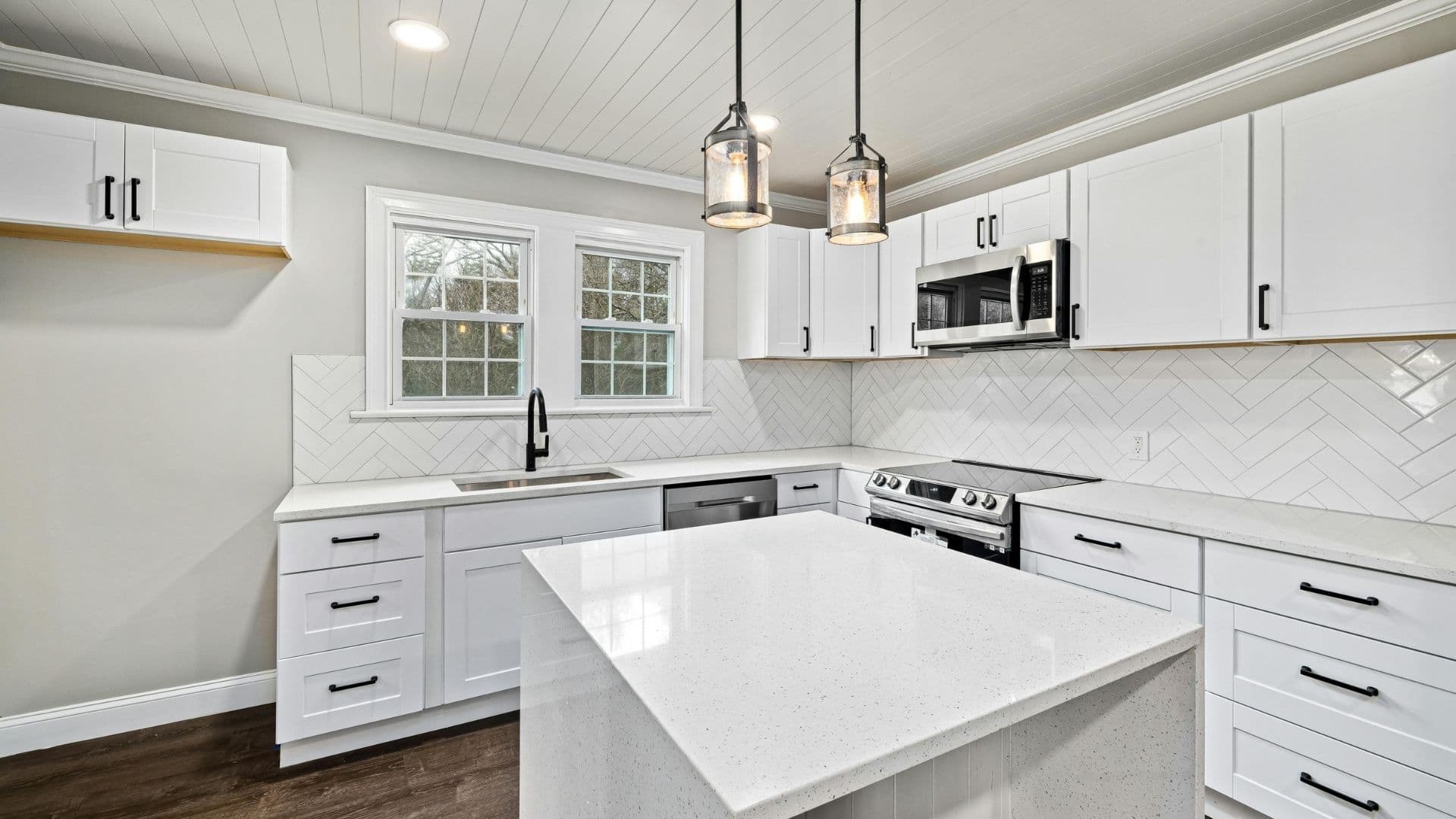
Open-concept kitchen remodels are HomeNest's most-requested scope. The galley or U-shape kitchen with a wall separating it from the dining and living areas was the standard for Capital Region homes built between 1950 and 1990 — exactly the housing stock that's being remodeled most actively in 2026. This guide walks through what opening up your kitchen actually involves, from the structural engineering through the final flooring transition.
Why homeowners want open-concept
The original pitch for open-concept was lifestyle: cooking while watching the kids, entertaining without being separated from guests, letting natural light reach further into the house. Those reasons still apply for most Capital Region families. Additionally, open-concept kitchens tend to feel larger and sell faster than compartmentalized equivalents in most Capital Region neighborhoods.
The tradeoffs are real: cooking smells and noise travel further, TV and conversation aren't acoustically separated from kitchen activity, and a messy kitchen is more visible from other rooms. Those tradeoffs don't bother most families, but they're worth acknowledging before committing.
Step 1: Determine if the wall is load-bearing
Not every wall is created equal. Interior walls come in two types:
- Non-load-bearing wallsare essentially partitions — they separate spaces but don't carry weight from above. Removing them is structurally straightforward (and cheaper).
- Load-bearing walls carry the weight of floors, ceilings, or roof above. Removing them requires a structural beam and supports to redistribute the load.
Quick indicators: walls that run perpendicular to the direction of floor joists are more likely load-bearing; walls directly below a second-story wall are likely load-bearing; exterior walls are essentially always load-bearing. But these are indicators, not proof — the reliable determination comes from a structural engineer or experienced contractor. HomeNest reviews every open-concept prospect with our structural engineer before quoting.
Step 2: Design the structural solution
For load-bearing walls, the wall comes out and a beam takes over the load path. Beam options:
- LVL (laminated veneer lumber) beam: strong, straight, cost-effective. Used in most residential Capital Region applications. Typically dropped below the ceiling line by 6-12 inches.
- Steel beam: stronger at longer spans, sometimes used where the beam needs to sit flush within the ceiling structure rather than below it. More expensive, more complex install.
- Flush beam: either LVL or steel, designed to sit entirely within the floor or ceiling joist space so no beam is visible from below. Expensive to engineer but delivers the cleanest ceiling line.
Cost for the structural work alone (engineering, permit, beam, posts, temporary shoring, patching): $6,000-$12,000 in a typical Capital Region home. More for long spans or flush-beam installations.
Step 3: Consider what else is in the wall
The wall you're removing isn't just framing. It might contain:
- Electrical circuits. Almost always. Outlets, switches, lighting circuits for the rooms on both sides. These get rerouted.
- Plumbing lines. Sometimes. Vent stacks or supply lines routed vertically through the wall. Relocating these can add $2K-$6K.
- HVAC ducts. Sometimes, especially in second-story wall removal. May require redesigning duct paths.
- Gas lines. Occasionally. Relocation requires certified gas-fitting work.
Before demo, we check the wall cavity thoroughly and plan relocations into the scope. Surprises behind drywall are expensive — good planning prevents them.
Step 4: Design the new layout
Opening up the kitchen changes how the entire main floor works. The design decisions that matter most:
Island placement and size
In most Capital Region open-concept remodels, the island becomes the anchor of the new space. Size the island to the room: 84 inches minimum length for seating two, 108-120 inches for seating four, 36-48 inches deep. Leave at least 42-48 inches clearance on all sides for traffic flow. Islands over 10 ft long may need seams in the counter and sometimes two support zones.
Work triangle
The classic work triangle (sink, range, fridge) still matters in open-concept designs. Keep the three points within 4-9 ft of each other and unblocked by the island. A sink on the island with range and fridge on the back wall is a common Capital Region layout that works well.
Cabinet height and scale
With the wall gone, the kitchen visually merges with the adjacent rooms. Tall upper cabinets to the ceiling (or as close as possible) make the kitchen feel intentional and anchored. Avoid a gap between cabinet tops and ceiling unless you have specific design reasons — it reads as outdated in an open-concept layout.
Lighting layers
Open-concept kitchens need more lighting than traditional ones because the space is larger and gets used for more activities. Layer: recessed can lighting on the ceiling, pendants over the island, under-cabinet lighting for task work, and decorative lighting (often a statement fixture over the dining area) for evening ambiance.
Step 5: Flooring transitions
One of the under-appreciated decisions in open-concept remodels: how flooring flows between the newly-connected spaces. Options:
- Continue existing flooring into the kitchen. If your dining/living rooms have hardwood, extend or refinish to match into the kitchen. Cleanest look.
- Replace all flooring to a unified material. Best for remodels that include a whole-home refresh. Works well with wide-plank engineered hardwood or large-format tile.
- Intentional transition line. Sometimes the right call if the kitchen flooring needs to be different (e.g., heated tile in the kitchen, hardwood everywhere else). Use a flush threshold with a planned transition line, not a ramped transition strip.
The wrong answer: an awkward flooring "island" where the kitchen flooring stops at the old wall line. Removes the benefit of opening up the space.
Step 6: Ventilation
A compartmentalized kitchen with a door can get away with a weak range hood because smells are contained. An open-concept kitchen without strong ventilation spreads cooking smells throughout the main floor. Plan for a 600+ CFM range hood vented to the outside (not recirculating). Induction cooktops reduce ventilation demand somewhat because they put less heat into the air.
Capital Region home considerations
Open-concept remodels in our market have local flavor:
- Ranches and splits in Clifton Park, Colonie, and Guilderland almost always benefit from opening up the galley kitchen. This is HomeNest's most common scope by volume.
- 1950s-1970s colonials across the region often have a compartmentalized kitchen-dining setup that opens up beautifully.
- Victorian homesin Albany's Center Square, Troy's Downtown, and Schenectady's Stockade benefit from careful thought before opening up. These homes have character value tied to their original room definitions. A "broken-plan" approach (partial walls, wide cased openings) often works better than full open-concept for historic homes.
- Newer subdivision homes (2000s+) often already have open-concept floor plans, so the remodeling question becomes about kitchen finish level rather than layout.
Total budget
A full open-concept kitchen remodel in the Capital Region typically runs:
- $45,000-$65,000: Mid-range remodel with LVL beam, semi-custom cabinets, quartz counters, mid-range appliances.
- $65,000-$90,000: Premium scope with upgraded beam installation, custom cabinetry, premium counters, higher-end appliances.
- $90,000+: Luxury scope with structural complexity, flush beam, full custom cabinetry, premium everything.
See our kitchen remodeling page for the full scope detail, and our cost breakdown for more pricing specifics.
When an open-concept kitchen isn't the answer
Open-concept isn't right for every home. Skip it if:
- You or other household members are noise-sensitive while working from home.
- Your home is a historic property where room separation has architectural value.
- Budget is limited and you'd rather spend it on finishes than structure.
- Your kitchen is already near the rest of the house and opening a wall wouldn't add much.
In those cases, a lighter-scope kitchen renovation or a whole-home home remodel that reconfigures flow without removing structural walls might serve better.
Start with a free consultation
Whether your kitchen is a good open-concept candidate depends on your specific home. A free in-home consultation includes a wall evaluation (load-bearing or not), a rough structural scope, and a ballpark budget. Our cost estimatorgets you a starting range. HomeNest has opened up dozens of Capital Region kitchens since 2019 — Fully Insured, Locally Owned and Operated, 5-Year Workmanship Warranty on every project.