
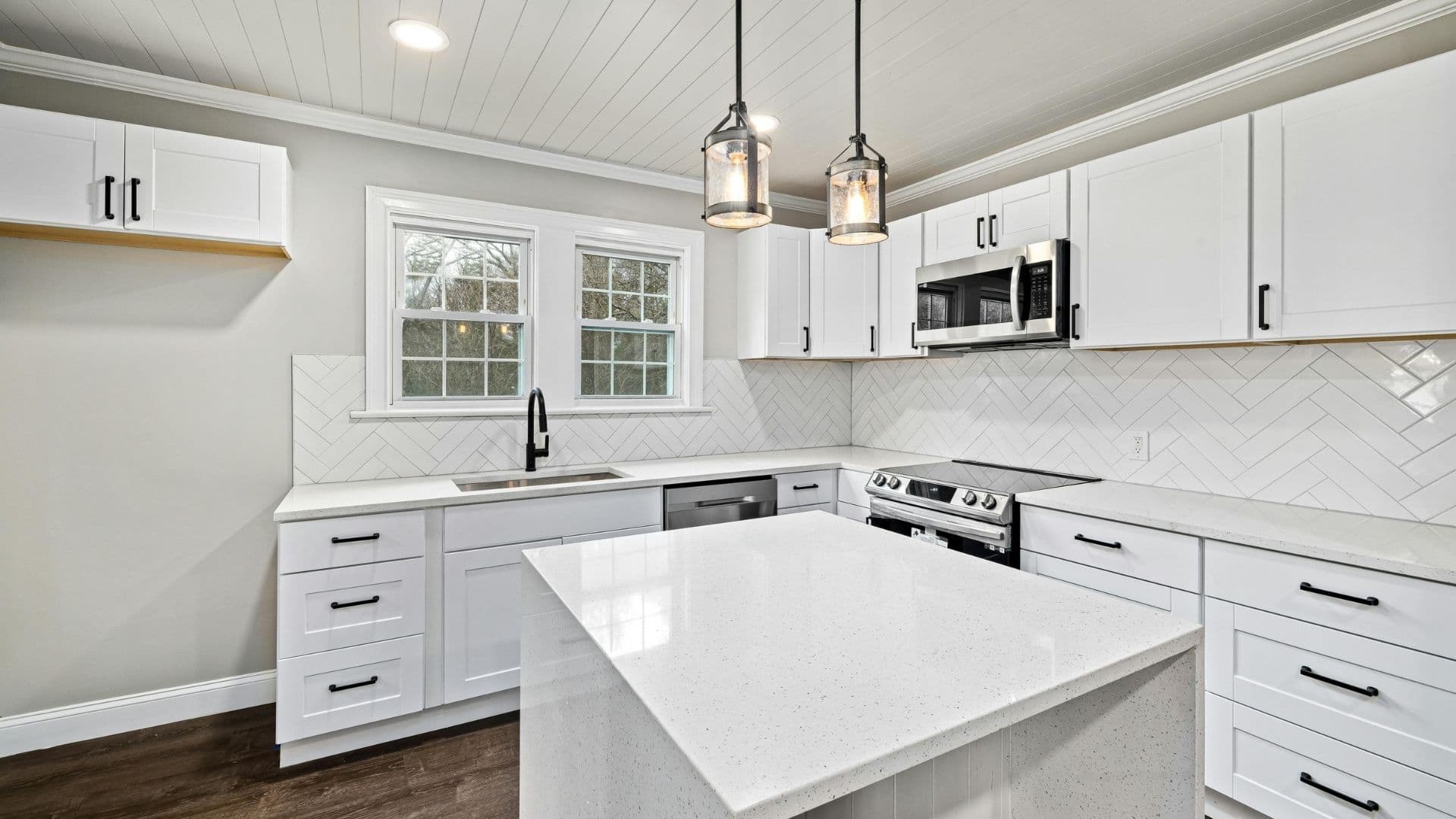
Kitchen remodels are the most-requested project at HomeNest, and they're also the project where homeowners are most likely to arrive with either unrealistically low or unrealistically high budget expectations. Social media and national remodeling shows don't tell the Capital Region story. This guide will.
Here's what Capital Region kitchen remodels actually cost in 2026, broken out by scope, component, and finish level — with ranges grounded in HomeNest's own project pricing across Albany, Clifton Park, Saratoga Springs, Troy, and the surrounding towns.
Typical Capital Region kitchen remodel cost ranges
Kitchen projects split into three scope tiers, each with its own price range:
- Kitchen renovation (lighter scope):$10,000–$30,000. Refinished cabinets, new counters, new fixtures, new backsplash. Keeps the existing layout and cabinet boxes. See our kitchen renovation page for the full scope.
- Full kitchen remodel (mid-range):$30,000–$55,000. New cabinets (semi-custom), new quartz counters, new tile backsplash, mid-tier appliance package, mid-tier plumbing fixtures. Layout may change slightly but structural walls stay.
- Full kitchen remodel (upper range):$55,000–$80,000+. Custom cabinetry, premium stone counters, high-end appliances, often with wall removal to open up the space. Our most-requested scope in Loudonville, Saratoga Springs, and upper Clifton Park markets.
- Luxury / gut-to-studs:$80,000–$150,000+. Full structural reconfiguration, designer cabinetry, specialty appliances, premium tile and stone throughout.
What actually drives the cost of a kitchen remodel?
Within any scope tier, several levers move the number significantly:
- Cabinet level. Stock cabinets run $5K-$10K; semi-custom $10K-$20K; full custom $20K-$40K+ for a typical kitchen. Cabinet choice is the single biggest variable.
- Counter material. Laminate $1,500-$3,000; solid surface (Corian) $3,000-$5,000; standard quartz $4,000-$7,000; premium quartz and quartzite $6,000-$12,000; high-end natural stone $8,000-$20,000+.
- Appliance package. Budget appliance package $4K-$6K; mid-range $6K-$10K; premium (Sub-Zero/Wolf) $18K-$35K+. Built-ins add more.
- Layout changes. Removing a wall (if load-bearing, with structural header and engineering) adds $6K-$12K. Moving plumbing adds $2K-$5K. Adding an island requires electrical and often plumbing $2K-$6K.
- Flooring. Engineered hardwood $6-$12/sq ft; large-format tile $8-$18/sq ft; premium tile or hardwood $15+/sq ft. A typical kitchen has 150-250 sq ft of flooring.
- Hidden conditions. Older Albany, Troy, and Schenectady homes often need electrical panel updates, plumbing replacement, or subfloor work. We price allowances for these in every quote.
Cost breakdown by component
Here's roughly how a $50,000 mid-range Capital Region kitchen remodel breaks out:
- Cabinetry (semi-custom):$14,000–$17,000. About 30% of the total.
- Counters (quartz) and installation:$5,000–$8,000.
- Appliances (mid-range package):$7,000–$10,000.
- Labor (design, project management, install, finish work):$14,000–$18,000. Roughly 30-35% of the total.
- Tile backsplash + flooring:$3,000–$6,000.
- Plumbing fixtures + rough-in:$2,000–$4,000.
- Electrical, lighting, smart switches:$2,000–$4,000.
- Permits, demo/disposal, allowances:$2,000–$3,000.
Capital Region pricing factors
Kitchen remodel pricing in the Capital Region has a few local quirks:
- Older homes.Victorian, Foursquare, and early-20th-century homes in Albany's Pine Hills and Center Square, Troy's Lansingburgh, and Schenectady's GE-era Woodlawn often add 15-25% for hidden conditions and working around plaster walls. Budget accordingly.
- Newer subdivisions.Clifton Park's Country Knolls, Halfmoon, and most Malta homes are structurally newer and finish-focused — kitchen remodels here run at or slightly below the mid-range.
- Market tier.Premium markets (Loudonville, Saratoga East Side, Slingerlands in Bethlehem) tend to see higher finish levels selected, which pushes costs up — not because of pricing but because of spec choices.
- Lead times. Custom cabinet and premium appliance lead times can be 8-14 weeks, which affects schedule, not price. We order early to avoid mid-project stalls.
Renovation vs. full remodel — when each makes sense
If your cabinet boxes are solid wood and the layout works, a kitchen renovationat $10K-$30K can deliver 70-80% of the visual transformation of a full remodel. That's real value if you're staying put for 5+ years or prepping for sale in the next 18 months.
A full kitchen remodelis the right scope if: your cabinets are particleboard or swelling, the layout fights your family's use of the space, you need modern mechanicals (new panel, new plumbing), or you want the kitchen to last another 20 years without major work. We wrote a full breakdown of renovation vs. remodel differences.
Where does the money go in a kitchen remodel?
When homeowners see a $50,000 quote, the natural question is “where is all of that going?” Understanding the proportions helps you make smarter trade-offs — spending more where it matters and trimming where it doesn't. Here's how a typical mid-range Capital Region kitchen budget divides up by category:
- Cabinetry — about 30–35%.On a $50K project that's roughly $15,000–$17,500. Cabinets are the visual backbone of the room and the line item with the widest swing, so this is where finish-level decisions hit hardest.
- Counters & tile — about 12–18%.Quartz counters, backsplash, and any accent tile typically land at $7,000–$9,000 combined for a mid-range spec.
- Appliances — about 15–20%.A mid-tier package of fridge, range, dishwasher, and vent hood runs $7,000–$10,000. Stepping up to paneled or built-in models pushes this share higher.
- Labor — about 25–35%.Design, project management, demolition, installation, and finish carpentry total $13,000–$17,500. This is the work that determines whether the kitchen still looks tight in year ten.
- Plumbing & electrical — about 8–12%.Fixtures, rough-in, lighting, dedicated circuits, and switching come in around $4,000–$6,000 in newer homes — more if an older Albany or Troy panel needs updating.
- Contingency — 10–15%.We always recommend reserving $5,000–$7,500 for hidden conditions: rotted subfloor, undersized wiring, or out-of-level walls that only reveal themselves after demolition. A funded contingency keeps a surprise from becoming a stalled project.
Use these proportions as a sanity check on any quote. If a bid skips a contingency line entirely, ask how change orders for hidden conditions will be handled. You can model your own split with our online cost estimator before you ever schedule a visit.
What does a real Capital Region kitchen remodel look like?
Numbers make more sense with a concrete picture. Here's a representative recent project — an illustrative composite of the kind of work HomeNest does most often, not a single named client. Picture a 1965 ranch in Latham, on the Colonie side of the line: a closed-off kitchen of roughly 170 square feet with original cabinets, a soffit dropping the ceiling, and a wall separating the kitchen from a cramped dining room.
The goal was an open layout. We removed the dividing wall — load-bearing, so it needed a structural header and a quick engineering sign-off — and reworked the run into an L-shape with a new island. The package was custom cabinets to the ceiling, quartz counters, a tile backsplash, engineered hardwood to match the adjoining living room, and a mid-range appliance suite. The crew was on site about 8–10 weeks, with the longest single wait being the custom cabinet lead time.
The all-in total landed in the upper-mid $50,000–$65,000 range. What drove the budget was the open-concept conversion: the wall removal, header, and relocated electrical added several thousand dollars over a same-footprint refresh, and ceiling-height custom cabinetry carried the rest. Homeowners weighing the same move should read our open-concept kitchen guide before committing to wall removal.
What is the return on a kitchen remodel?
Capital Region kitchen remodels typically recover 60-75% of cost at resale based on industry cost-vs-value data. Upscale remodels recover a lower percentage but add more absolute dollars; mid-range remodels recover a higher percentage but less absolute dollar value. For most Capital Region homeowners staying 5+ years, the quality-of-life return over that period matters more than the resale math.
Get a real number for your project
Ballpark ranges are useful for planning. A more accurate number comes from our online cost estimator, which factors in your specific scope/size/finish choices. A free in-home consultation gives you a fixed-price written proposal within a few days. HomeNest handles permits, design, materials, and build across the full Capital Region — Fully Insured, Locally Owned and Operated, Since 2019.